Archive for the 'Golf Articles' Category

Conquer The Perimeter For A Better Golf Handicap

Monday, November 16th, 2009

The perimeter around the green is the single most important area in golf. Players who have solid games from there always score better than those who don’t. Unfortunately, many golfers with high golf handicaps don’t practice their perimeter skills. Chipping a few balls before playing isn’t practicing. Neither is taking golf lessons or reading golf tips. If you want to improve your perimeter game, you must take practice seriously.

Weekend golfers don’t usually practice much because it’s work. It’s also boring. Using drills when practicing changes these feeling. It’s also a good way to improve. Not only do drills sharpen your skills efficiently. They’re also are fun to do—especially if you do them with a friend. Using drills also gets you to practice longer. More practice helps you groove the proper swing and tempo.

Let’ look at drills for three common greenside scenarios. Practicing them will help you turn three strokes into two next time you play:

The Basic Chip
The basic chip is easy to execute. It’s ideal when you have a lot of green to work with. It’s also a frequent perimeter scenario, one that teachers often cover in golf instruction sessions. Your setup for this shot is key. Play the ball in the middle of your feet, your shoulders square, hands in front of the ball, and feet slightly open. Place about 60 percent of your weight on your front foot, which encourages a downward blow. Use a light grip pressure and a wedge you like. Some use a 56-degree wedge.

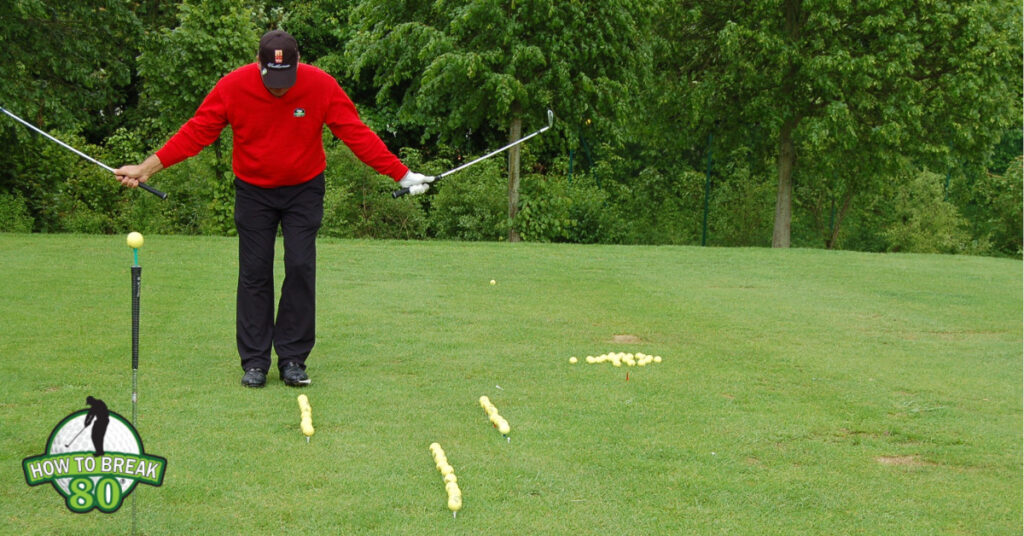
Drill: Place two balls about a driver’s length apart. Place your bag (or another obstacle) behind the back ball. Now drop a ball in the middle of these balls and take your chipping stance. Give yourself a good lie. Later, you can vary your lie. Now, chip the ball. If you swing back to the ball/bag and forward to the front ball, you should fly the ball about seven yards. To hit it less than seven yards, separate the two balls with a shorter club. Practice this drill until you can get it close on command.

The Choke Down
No two courses are alike. You don’t need golf lessons to realize that. Golf courses vary in the conditions of the fairways and tee boxes, and the speed of the greens. They also vary in the texture of their bunkers. The choke down shot is perfect for firm or wet bunkers. Play the ball forward from a normal bunker stance, with about 70 percent of your weight on your front foot. The key here is not releasing the club through impact. So keep your wrists firm so the club head doesn’t release.

Drill: A good way to ingrain this “no-release” feeling is to grip the club well down on the shaft. First, find a practice bunker and setup as you would for a normal bunker shot. Now, go almost down to the hosel. Leave about six inches between your hands and the hosel. Now take a swing. Make sure the club’s shaft doesn’t hit your body. This drill helps groove the feeling of keeping your wrists firm through impact.

A Tight Lie
Tight lies around the perimeter are killers. Since they come up frequently around the perimeter, perfecting this shot helps cut your golf handicap significantly. The key is to keep your swing on plane. Set up with a square stance and square shoulders. Play the ball in the center of your stance. And grip the club normally. Again, shift 70 percent of your weight on your front foot to help produce a downward blow.

Drill: Place two stand bags on the target line—one in front of you and one in back of you. Both bags are angled so the clubs are pointing toward you. When in position, they both rest at a about 45-degree angle, perfect for creating the ideal angle of attack for a good swing plane. On the backswing, you want the clubshaft parallel to the back bag. On the follow through, you want the shaft parrallel to the front bag. This is called being on plane.

The trick to improving your golf handicap is conquering the green’s perimeter. Good players almost always have solid perimeter games. Good perimeter game turns three shots into two time and time again, as I’ve written in my golf tips. Use the three drills above to make practice fun and interesting. They’ll sharpen your short game skills and help you master key perimeter shots.

Jack Moorehouse is the author of the best-selling book “How To Break 80 And Shoot Like The Pros.” He is NOT a golf pro, rather a working man that has helped thousands of golfers from all seven continents lower their handicap immediately. He has a free weekly newsletter with the latest golf tips, golf lessons and golf instruction.

Share and Enjoy:
  • Digg
  • Technorati
  • blinkbits
  • blogmarks
  • De.lirio.us
  • del.icio.us
  • Fleck
  • Slashdot
  • YahooMyWeb

How To Become A Great Shotmaker (Part II)

Wednesday, November 11th, 2009

This is the second of two articles on shotmaking—the key to dramatically cutting strokes from your golf handicap. The first article explained how to hit four key shots—a high draw, 100-yard knockdown, semi-buried bunker blast, and a chip with a hybrid. This article explains four more key shots—the thick rough pitch, 3-wood punch, mid-iron fade, and bump-and-run. These shots help trim strokes from your golf handicap.

All golfers want to become great shotmakers. That’s because it takes your game to the next level. Good shotmakers magically turn three shots (or more) into two. But becoming a great shotmaker isn’t easy. The secret is learning to hit certain key shots and practicing them until you’ve mastered them. These common but critical shots save you when in trouble. They’re the kind that golfers often ask me for golf tips on. Master them and you can play with anybody.

Thick Rough Pitch
This shot helps you get up and down. The key to this pitch is cocking your wrists early in the swing and releasing them fully through impact, just like you’re taught in golf lessons. The goal is to get out of the rough going in the right direction. Trying to do too much here hinders the shot. Think of it as if it were a semi-buried bunker blast. You want to get out in one.

To hit this shot, use a low-bounce iron or wedge. Play the ball back in your stance, open your feet slightly, and place your hands above the ball. Also, increase grip pressure slightly, which helps drive the clubface through the thick grass, and aim the clubface square to the target. Now, accelerate and hit down. Plan for an abbreviated finish and expect a lower ball flight with extra roll.

3-Wood Punch
Use this shot when the driver gets you in trouble. It gets you back on the fairway in good shape for the next shot. Align yourself parallel to the target. Position the ball slightly back from normal. And strengthen your left hand grip (right hand grip for left-handers), lessening your wrist cock and shortening your overall swing. Set the club head first, then the forward lean in the shaft toward the target. But be careful. The forward lean makes it look like the clubface is open.

Two key golf tips here are (1) take the club back inside the target line and (2) start hinging your wrists when the club gets about knee high. These moves steepen your swing significantly, helping you hit a low, punch shot.

Mid-iron Fade
Use the mid-iron fade when needing a high, soft-landing shot. Aim your body slightly left (right for left-handers) of target at address. Position the ball in its normal spot. And squeeze the grip of your left hand slightly (right for left-handers), delaying the release of your hands through impact. Also, open the clubface slightly to help you put cut spin on the shot.

The key to this shot is making sure the left arm (right for lefties) leads the right side of the body through impact, as I tell students in my golf lessons. So take the club back slightly on an outside-to-in path and hinge your wrists earlier than normal. This primes your swing to hit the fade.

Bump-And-Run
This shot is a great stroke saver when you’re within a 100 yards of the green. The goal is to get the ball to bounce a couple of times short of the green, and then roll close to the hole. Use a hybrid, an 8-iron, a 9-iron, or a pitching wedge, but not a sand wedge. It puts too much spin on the ball. Expect the ball to pop up, hit the ground, and then run to the hole.

To hit this shot, take a slightly closed stance, play the ball back, lean the shaft forward slightly, and hinge your wrists. Maintain the wrist set to the finish. Pivot your chest toward the target as your arms swing through. Make a descending blow and swing in a shallow U-shaped arc, taking a small divot in front of the hole. At the finish, the club’s toe points skyward

The eight shots described in these two articles are lifesavers. If you’re serious about shaving strokes of your golf handicap, you’ll learn them. Study golf tips on them. Take golf lessons on them. And practice them. Do whatever it takes to master them. Once mastered, they’ll help take your game to the next level.

Jack Moorehouse is the author of the best-selling book “How To Break 80 And Shoot Like The Pros.” He is NOT a golf pro, rather a working man that has helped thousands of golfers from all seven continents lower their handicap immediately. He has a free weekly newsletter with the latest golf tips, golf lessons and golf instruction.

Share and Enjoy:
  • Digg
  • Technorati
  • blinkbits
  • blogmarks
  • De.lirio.us
  • del.icio.us
  • Fleck
  • Slashdot
  • YahooMyWeb

Maximizing Distance Off The Tee

Monday, November 9th, 2009

Maximizing distance off the tee starts with your setup. The right setup produces a smooth fluid swing that allows golfers to take advantage of a driver’s loft. A poor setup opens up power leaks. Unfortunately, weekend golfers don’t always setup correctly for hitting the long ball. So they have leaks that drain their swings of power. If want to add serious distance to your drives, try incorporating the setup adjustments we describe below. Doing so can transform your drive and make a big difference in your golf handicap.

To Flare Or Not To Flare
How you set up your feet helps determine how much power you deliver at impact. Some golf instruction sessions teach weekend golfers to widen their stances a bit and flare their front foot for more power. These adjustments increase the speed at which your hips unwind and enable you to swing the club faster. But what if your hips already unwind too fast on the downswing? In that case turn your foot in and use a narrower stance. These adjustments restrict the unwinding of your hips on the downswing, providing more consistency on your drives.

Neutralize Your Grip To Hit A Fade
Players often read golf tips that say you must hit a draw to hit it farther. But that’s not the only way to hit it long. Some golfers, Jack Nicklaus included, like to hit a power fade off the tee. Employing a power fade allows you to hit the ball higher and maximize carry distance. Generally speaking, the longer the ball stays airborne the farther it goes. You can hit a power fade by weakening your grip. To do that, lay the thumb of your glove hand on the shaft so that the crease made by the thumb and index finger points more toward your chin than your right shoulder (left shoulder for left-handers).

Sweep The Ball
The quickest way to launch a ball off the tee is to change your angle of attack. That’s the angle at which the clubhead travels on its way to impact. Hitting the ball on a downward path results in a negative angle of attack. Hitting the ball on the upward path results in a positive angle of attack. No great driver, as I once read in a golf tips magazine, employs a negative angle of attack. Instead, they use a positive angle of attack. They sweep the ball off the tee. To do this, set your spine angle at address so your front shoulder is higher than your back shoulder. This adjustment lets you shallow out your swing so you can hit the ball on the upswing at the optimum launch angle.

Pause At The Top
The final adjustment in maximizing distance off the tee is making a full shoulder turn, as I’ve said often in my golf tips and golf lessons. Pausing at the top of your swing for a split second helps you do this. It also helps get everything in sync before making a smooth transition to your downswing. But many weekend golfers make a sloppy transition. If you pause at the top of your swing, you can swing as hard as you want on the downswing and still stay in rhythm.

If you’re serious about maximizing your distance off the tee—and increase your chances of shaving strokes off your golf handicap—get the ball airborne. Swing speed is a key to hitting the ball great distances. So is leg strength, which helps determine how quickly you can turn your hips. A third factor to launching it long and far is loft. The higher you hit the ball with the right amount of spin, the father it goes. Launching a ball with the right amount of spin at setup. Use the adjustments discussed above to help you setup for maximum distance off then tee.

Jack Moorehouse is the author of the best-selling book “How To Break 80 And Shoot Like The Pros.” He is NOT a golf pro, rather a working man that has helped thousands of golfers from all seven continents lower their handicap immediately. He has a free weekly newsletter with the latest golf tips, golf lessons and golf instruction.

Share and Enjoy:
  • Digg
  • Technorati
  • blinkbits
  • blogmarks
  • De.lirio.us
  • del.icio.us
  • Fleck
  • Slashdot
  • YahooMyWeb

Sink More Putts With The Quiet Eye

Wednesday, October 28th, 2009

What’s the difference between you and a great putter? It just might be the Quiet Eye. In putting as well as in other hand-eye-target skills, the Quiet Eye is emerging as a key indicator of optimal focus and concentration. It’s this focus and concentration, research shows, that sets the good putter apart from the poor one. Fortunately, achieving this focus and concentration is a skill that can be taught in golf lessons or learned on one’s own and can help drive down a player’s golf handicap.

Usually, we attribute the difference between a good putter and a poor putter to mechanics. Good mechanics produces good putting. Bad mechanics produces bad putting. Good mechanics are what most golf lessons and golf tips emphasize. And that’s fine. You can’t be a superior putter if your mechanics are wrong. But mechanics aside, what else makes one golfer a better putter than another? Research shows that focus and concentration is the difference, underscoring the importance of the Quiet Eye.

The Quiet Eye
Simply put, the Quiet Eye occurs when your gaze remains absolutely still on the ball just before and as the stroke is performed. Two key elements in the Quiet Eye are location and duration. Research shows that golfers who putt well focus on either the back or the top of the ball. Which is better? Both locations improve accuracy, but a weight of evidence now favors the back of the ball. As for duration, good putters have a Quiet Eye duration of two or three seconds on average. Less skilled player held their gaze steady for one or two seconds on average.

Why is the Quiet Eye so critical when you putt? Your hands are controlled by your brain, which gets valuable information from your eyes. As you putt, your brain must organize 100 billion neurons. Your gaze keeps these neural networks informed. They in turn control both your hands and body when putting. But these networks stay organized for only a short period, creating a window of opportunity that must be used when it’s at its most optimal: This is the Quiet Eye period.

Unfortunately, the Quiet Eye is the first thing to go when under stress. It moves with the stroke. When you choke, the billion cells in your brain lose their effectiveness in solving the putt’s slope, curvature, distance, and location problems. Even hours of golf instruction sessions and practice focused on mechanics may not be able to save you when the pressure is on. On the other hand, developing proper mechanics builds confidence—another key element in putting. But confidence may not be as critical to putting accuracy as the Quiet Eye.

Developing the Quiet Eye
Routine Research shows that an average golfer using a pre-shot routine based on the Quiet Eye sinks more putts than when not using the routine—whether the routine is learned in golf lessons or self-taught. Visualization is a key element of this routine.

Focus on the hole
Once your putterhead is set behind the ball, pick a specific location on the hole where you want the ball to go, like a blade of grass or a small feature on the cup’s front lip.

“See” the ball go in
Look at this location for about two seconds. Visualize the ball going into the hole.

Scan from the hole to the ball
Smoothly shift your gaze without interruption from the target to the back of the ball. Your gaze should move efficiently and calmly.

Eye on the ball
Fixate on the back of the ball. Imagine just the right contact of the putterhead on the ball. Picture a line through this contact point to your spot on the hole.

Stay steady
Maintain a Quiet Eye on the one spot on the back of the ball from the backstroke through contact. Don’t peek! Take a look at your ball going in the hole only after putting.

The Quiet Eye may be an objective measure of “being in the Zone,” according to some experts. This idea of being in the Zone, or in the “flow,” as some athletes say, has been around for a long time. But until now, there has been little scientific evidence that the Zone exists—let alone can be measured. Developing the Quite Eye technique might not only help you access the zone when putting, it might also help you achieve better putting accuracy, knocking strokes off your golf handicap.

For more about the Quiet Eye, see the Quiet Eye Web site (http://quieteyesolutions.com) or the Web site of Dr. Joan Vickers (http://www.kin.ucalgary.ca/nml) , a leading researcher in this area.

Jack Moorehouse is the author of the best-selling book “How To Break 80 And Shoot Like The Pros.” He is NOT a golf pro, rather a working man that has helped thousands of golfers from all seven continents lower their handicap immediately. He has a free weekly newsletter with the latest golf tips, golf lessons and golf instruction.

Share and Enjoy:
  • Digg
  • Technorati
  • blinkbits
  • blogmarks
  • De.lirio.us
  • del.icio.us
  • Fleck
  • Slashdot
  • YahooMyWeb


Tools To Help Your Game!

How To Break 80 eBook
eBook

How To Break 80 Physical Book
Physical Book

How To Break 80 Audio Program
Audio Program

How To Break 80 Short Game DVD
Short Game DVD

How To Break 80 Driver DVD
Driver DVD

How To Break 80 Putting DVD
Putting DVD

How To Break 80 Draw DVD
Draw DVD

How To Break 80 Bunker DVD
Bunker DVD

How To Break 80 Full Swing DVD
Full Swing DVD

Driver DVD